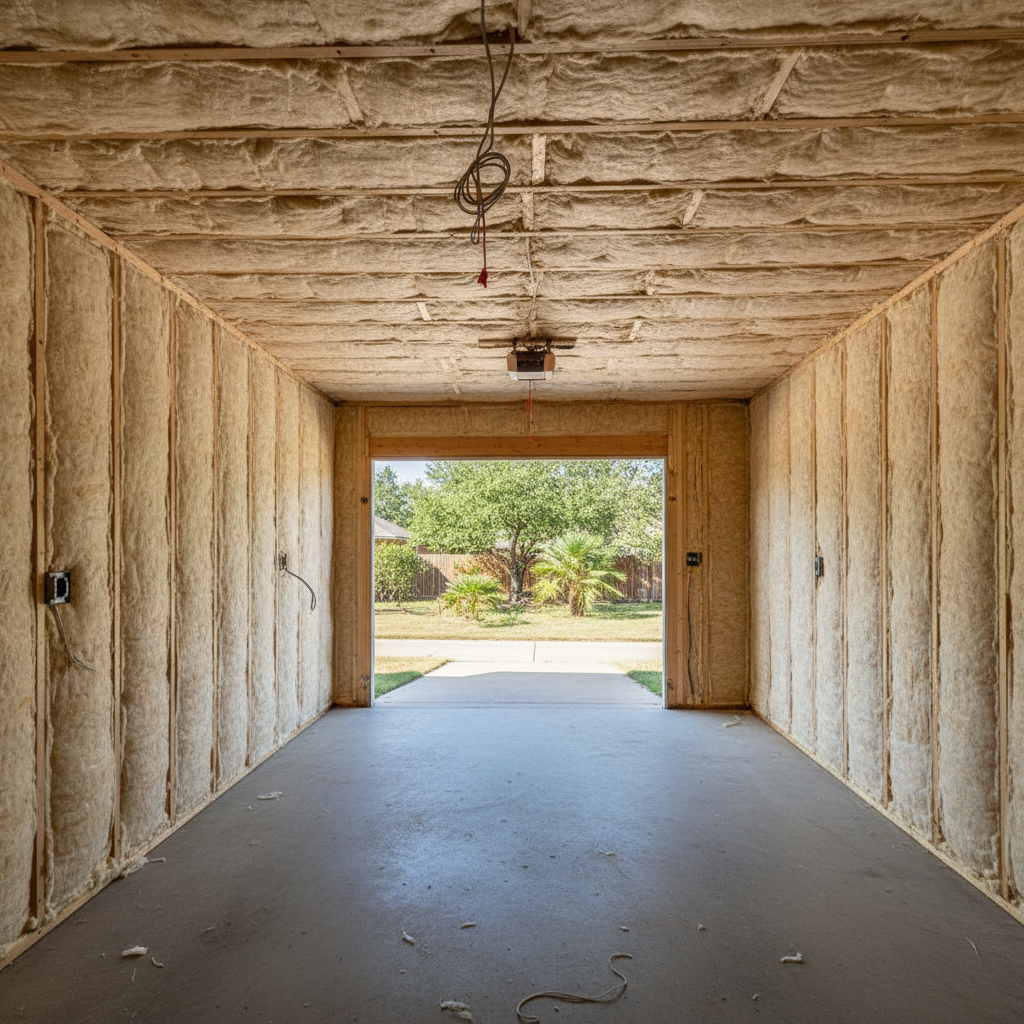
You're probably asking yourself, "How much is this going to set me back?" when you think about insulating your garage. It's a fair question, and one I get a lot from folks here in Fort Worth. A lot of contractors will just tell you "it depends," and while that's true to an extent, it's not helpful. I'm going to give you some real numbers and tell you what actually goes into that final price tag.
What Makes Garage Insulation Prices Jump Around?
There isn't a one-size-fits-all price for insulating a garage, and that's because a few key things change the game:
- The Type of Insulation You Pick: This is probably the biggest factor. You've got your traditional fiberglass batts, blown-in cellulose, and then there's spray foam. Each has its own cost per square foot, and the R-value you're aiming for plays a role too. Higher R-value generally means more material or a denser application, which costs more.
- Size of Your Garage: Pretty obvious, right? A single-car garage is going to be cheaper than a three-car monster. We're talking about square footage of walls and ceilings that need covering.
- Condition of the Space: Is it a brand-new build with open studs? Or an older garage with existing drywall that needs to be removed and replaced? Demolition and hauling away old materials add to labor costs. If there's a bunch of junk in the way, that's extra time for us to clear it out before we can even start.
- Accessibility: Can we easily get to all the areas that need insulating? If we're crawling into tight attic spaces or working around a bunch of stored items, it takes longer and can be more difficult.
- Air Sealing Needs: Insulation is only part of the equation. If your garage has a bunch of gaps and cracks, we'll need to seal those up first. This is crucial for performance but it's an extra step.
- Permits (Sometimes): For bigger jobs, especially if you're doing a full garage conversion, you might need a permit from the city. That's a separate cost and process.
Typical Cost Ranges for Garage Insulation in Fort Worth
Alright, let's get to some numbers. Keep in mind these are averages for Fort Worth and the surrounding areas. Material costs can fluctuate, but this should give you a solid ballpark.
Fiberglass Batts (Walls & Ceiling): For a standard two-car garage (around 400 sq ft), you're typically looking at $1.00 - $2.50 per square foot for materials and installation. This means a total of $800 to $2,000. This is often the most budget-friendly option, especially if you're just insulating exposed studs.
Blown-In Cellulose (Attic/Ceiling): If you're just doing the attic space above your garage, blown-in cellulose can run you about $1.20 - $2.80 per square foot. For that same two-car garage ceiling, that's roughly $480 to $1,120. It's good for filling irregular spaces and often has recycled content.
Spray Foam Insulation (Walls & Ceiling): This is where you get the biggest bang for your buck in terms of performance, but it's also the most expensive upfront. For open-cell spray foam, expect to pay around $1.75 - $3.50 per square foot. Closed-cell, which is denser and offers a higher R-value per inch, can be anywhere from $2.75 - $5.00+ per square foot. For a two-car garage, that could be anywhere from $1,400 to $4,000+ depending on the type and depth. We often recommend spray foam for garages here at Fort Worth Spray Foam Insulation because it handles our wild Texas weather swings so well and seals everything up tight.
These numbers usually include basic labor and materials. If there's demolition, extensive prep, or specialized equipment needed, those costs will be higher.
What Should a Good Quote Include?
When you get a quote from me or any other reputable contractor, it shouldn't just be a single number. You want to see a breakdown. Here's what I always make sure to put in writing:
- Specific Insulation Type & R-Value: Exactly what material we're using and what R-value we're aiming for.
- Total Square Footage: Clear measurements of the areas being insulated.
- Preparation Work: Any demo, debris removal, or sealing that's part of the job.
- Labor Costs: How much for the crew to do the work.
- Material Costs: The price of the insulation itself.
- Cleanup: What's included in the post-installation cleanup.
- Warranty Information: What kind of guarantee you're getting on the work and materials.
- Timeline: An estimated start and completion date.
If a quote just gives you a lump sum, ask questions. A good contractor will be happy to explain everything.
How to Avoid Overpaying for Garage Insulation
Nobody wants to get ripped off. Here's how you can make sure you're getting a fair deal:
- Get Multiple Quotes: Don't just go with the first guy who shows up. Get at least three detailed quotes. This helps you compare apples to apples.
- Check References & Reviews: See what other folks in Fort Worth have to say about the contractor. Look for local reviews, not just national ones.
- Understand the R-Value: Don't just ask for insulation; ask for a specific R-value. This ensures you're comparing similar products across different quotes. For a garage, especially if it's attached to your house, you want something substantial.
- Ask About Air Sealing: Insulation without proper air sealing is like wearing a winter coat with the zipper open. Make sure it's part of the plan, or at least discussed.
- Don't Rush: Take your time to review the quotes and ask all your questions. A reputable company won't pressure you.
Insulating your garage is a smart move, whether you're trying to keep the heat out during our brutal Fort Worth summers or just make your workshop more comfortable year-round. Do your homework, get solid quotes, and you'll get a great result without emptying your wallet unnecessarily.